Why Enterprise AI Needs an Organizational Intelligence Layer
Every system knows something important. Real decisions require them all. Enterprise AI needs a connective layer that brings an institution's distributed intelligence together at the moment it matters.
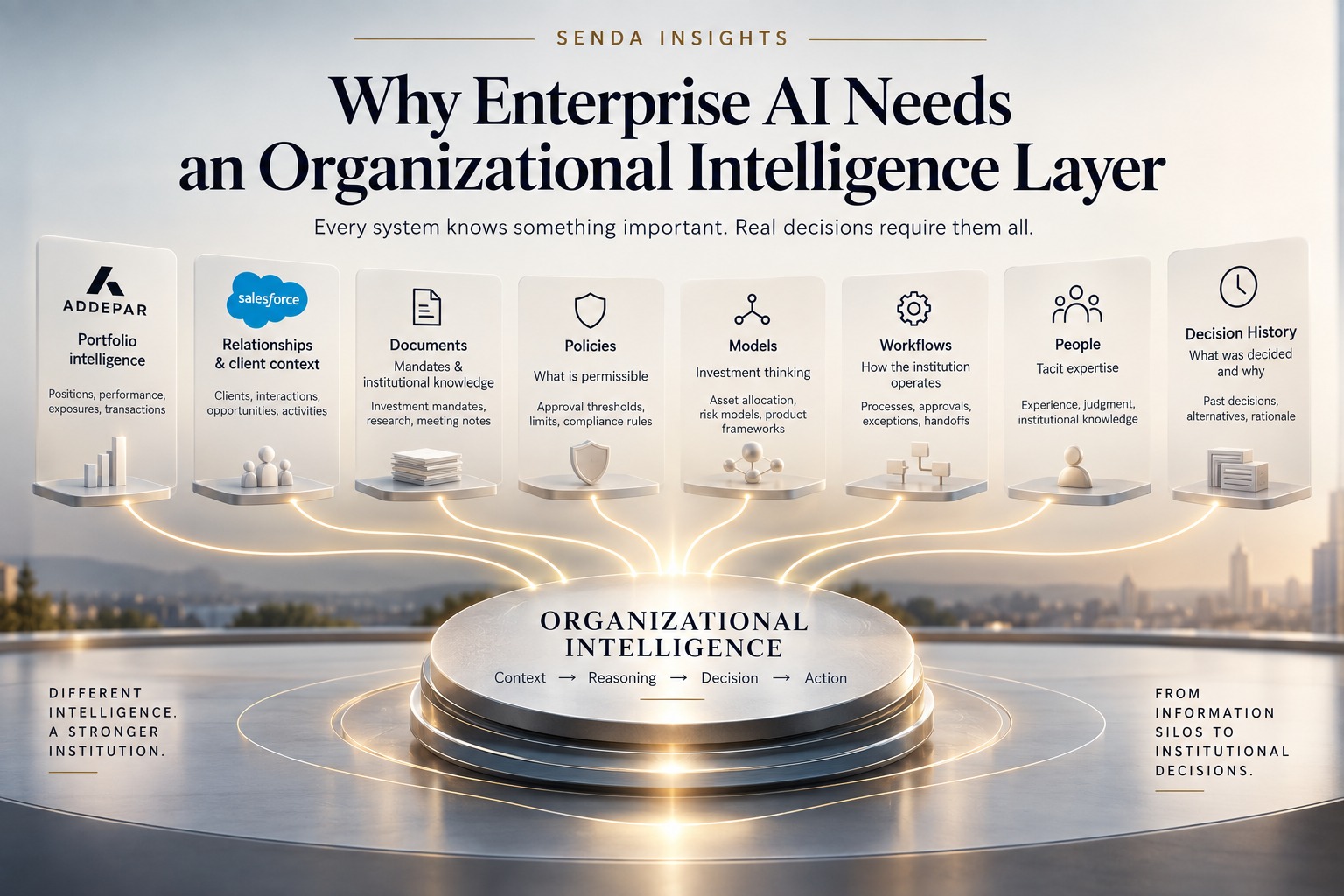
Wealth managers are rapidly adding AI to CRMs, portfolio platforms and other core systems. Each can make its own domain considerably more intelligent. But institutions do not make decisions inside individual applications. Decisions emerge from the interaction of portfolios, relationships, mandates, policies, models, workflows, people and institutional memory.
Making every application intelligent may therefore be very different from making the organization intelligent.”
A quiet assumption is beginning to shape enterprise AI strategies. If the CRM already sits at the centre of the client relationship, perhaps adding sufficiently capable AI to it can create the intelligence layer for the wealth manager. If a portfolio platform already contains investment positions, performance and exposures, perhaps its AI can play that role instead. Similar arguments can be made for document platforms, workflow systems and enterprise data infrastructure.
The logic is understandable. These systems already contain enormous amounts of valuable information. They are deeply embedded in how institutions operate, and the companies behind them are investing heavily in AI. Over time, the AI capabilities within each of these systems are likely to become considerably more sophisticated.
But there is a fundamental limitation to this view.
The system that knows the most about one part of the institution does not necessarily know the institution.”
A wealth manager does not operate through portfolios alone. Nor does it operate through client relationships, documents, investment models or workflows independently. The institution operates through the interaction between all of them. This distinction mattered less when technology primarily recorded information or automated processes. It matters considerably more when AI begins participating in analysis, recommendations and decisions.
The Intelligence of an Institution Is Distributed
Consider where the knowledge required to run a modern wealth manager actually resides.
A portfolio platform such as Addepar may know positions, performance, exposures, transactions and complex ownership structures. A CRM such as Salesforce may know relationships, interactions, opportunities, activities and important elements of client context. Neither source is peripheral. Both contain information that can materially affect a client decision.
But much of what matters exists elsewhere. Investment mandates, trust documents, meeting notes and research contain knowledge that may never appear cleanly in a database. Policies determine what the institution permits, what requires approval and when an exception should be escalated. Models encode investment thinking through asset-allocation methodologies, risk frameworks, product-selection criteria and other analytical approaches.
Workflows contain another kind of institutional knowledge. They encode how work actually moves through the organization: who is responsible, what happens next, where approvals occur and how exceptions are handled. People carry perhaps the hardest intelligence to capture—the accumulated judgment of relationship managers, investment professionals and operations teams who understand clients and the institution in ways that no database fully represents. Decision history adds another dimension by preserving what was previously decided, what alternatives were considered and why a particular course of action was chosen.
Each of these sources can become more intelligent through AI. But none, individually, represents the intelligence of the organization. That becomes obvious when the institution has to make a real decision.”
A Decision Rarely Belongs to One System
Imagine a relationship manager preparing for a review with a family and asking a seemingly simple question: What should we discuss with this client?
The CRM may know that succession planning was discussed at the previous meeting. The portfolio platform may identify that a concentrated equity position has appreciated substantially and that available liquidity has declined. The client's mandate may require liquidity above a particular threshold, while an institutional policy may require additional approval before increasing exposure to a certain asset class.
At the same time, the investment team's models may indicate that the portfolio has moved outside its preferred allocation range. A workflow may show that a significant capital call is expected within the next two months. An experienced advisor may know something that exists in none of these systems: the family has historically been reluctant to sell the concentrated holding because of its connection to the family business. Decision history may then reveal that the investment committee considered reducing the position six months earlier but deliberately deferred the decision.
Every system has contributed something important. Yet no individual system has enough context to answer the original question.”
The appropriate recommendation emerges from the interaction between portfolio intelligence, relationship context, mandates, policies, investment thinking, workflow state, human judgment and previous decisions. That is the organizational-intelligence problem.
Intelligent Applications Can Still Create an Unintelligent Organization
The enterprise software industry is understandably embedding AI into almost every application. CRM AI can make relationship management substantially better. Portfolio AI can accelerate investment analysis. Document AI can make institutional knowledge easier to retrieve. Workflow AI can automate individual processes and increasingly take actions on behalf of users.
All of this creates value. But it also introduces a subtle architectural risk. Institutions could reproduce their existing application silos as intelligence silos.
The CRM develops an increasingly sophisticated understanding of the client. The portfolio platform develops an increasingly sophisticated understanding of investments. Document systems become better at retrieving knowledge, while specialized agents become capable of executing increasingly complex workflows. Each application may become remarkably intelligent within its own boundary. The organization can nevertheless remain dependent on people to connect those boundaries.
This is why making every application intelligent is not the same as making the organization intelligent. The problem is not that the individual systems lack intelligence. It is that institutional decisions frequently require intelligence that exists across them.
From Systems of Record to Systems of Decision
Enterprise technology has historically been organized around systems of record. The CRM is authoritative for relationship information. The portfolio platform is authoritative for portfolios. Document repositories preserve institutional documents. Workflow systems manage processes. These systems remain essential, and AI does not diminish their importance.
But a decision has a different architecture. A decision may begin with data from several systems of record, but it must often incorporate institutional policies, analytical models, client mandates, workflow state, previous decisions and human judgment before an action can be taken. It must also respect permissions, governance and accountability throughout that process.
This suggests the emergence of another layer in enterprise architecture: an organizational intelligence layer.
Its purpose is not to replace the CRM, the portfolio platform or any other core system. Nor is it simply another repository into which the institution copies all of its information. Its role is to assemble the relevant institutional context around a decision and orchestrate the different forms of intelligence required to make and execute it.
The distinction is important. A portfolio platform should continue to be excellent at portfolio intelligence. A CRM should continue to be excellent at relationship intelligence. Documents should remain governed sources of institutional knowledge, while investment models should continue to encode the institution's analytical thinking. The organizational intelligence layer makes these capabilities more valuable by allowing them to participate in decisions together.
From Asking an Application to Asking the Institution
This may ultimately be one of the more consequential changes AI brings to enterprise software.
Today, many employees still have to understand the architecture of their institution in order to find an answer. An advisor goes to the CRM for relationship information, the portfolio system for investments, the document repository for a mandate, another application for workflow status and perhaps a colleague to understand why something happened six months earlier.
The user becomes the integration layer, assembling the context required to make a decision.”
AI creates the possibility of changing that abstraction. Instead of asking, “What does our CRM know about this client?” or “What does our portfolio platform know about this account?”, the user should increasingly be able to ask: “What does our institution know about this client, and what should we do?”
The difference between those questions is much larger than it initially appears. The second requires the institution to understand not only data, but context. It requires policies to determine what is permissible, models to provide analytical reasoning, workflows to determine what can happen next, institutional memory to provide historical context and people to remain involved where judgment or approval is required. It also requires the resulting decision to be explainable and traceable back to the intelligence that produced it.
A language model alone cannot provide that architecture. Nor can simply connecting every source of information to a chatbot. Organizational intelligence depends on the institution retaining control over how context is assembled, how different forms of reasoning are applied and how decisions move from analysis to action.
The Institution Does Not Need Another System to Replace Everything
There is a tendency for major technology shifts to create predictions that the existing enterprise stack will disappear. AI may produce a different outcome.
The CRM will remain valuable. Portfolio platforms will remain valuable. Data infrastructure, documents, models and workflow systems will remain valuable. In many cases, AI will make each of them considerably better. What changes is the connective layer between them.
For decades, institutions have accumulated enormous amounts of intelligence across systems, documents, processes and people. Much of that intelligence has remained fragmented because combining it at the moment of a decision required considerable human effort. AI now makes it possible to connect those forms of intelligence dynamically—but only if the architecture is designed around the institution rather than around any single application.
That leads to a different way of thinking about the next generation of enterprise AI. The objective may not be to find the one application that becomes intelligent enough to run the organization. It may be to create an intelligence layer that allows the organization to use all of the intelligence it already possesses.
The systems remain. The people remain. The institution's investment philosophy, policies and operating model remain its own. What changes is its ability to bring them together at the moment they matter.
The next competitive advantage may therefore come not from which enterprise application has the most powerful AI, but from whether the institution can make its collective intelligence work as one.”
Senda Editorial Team
Research & Insights

